
Product Details
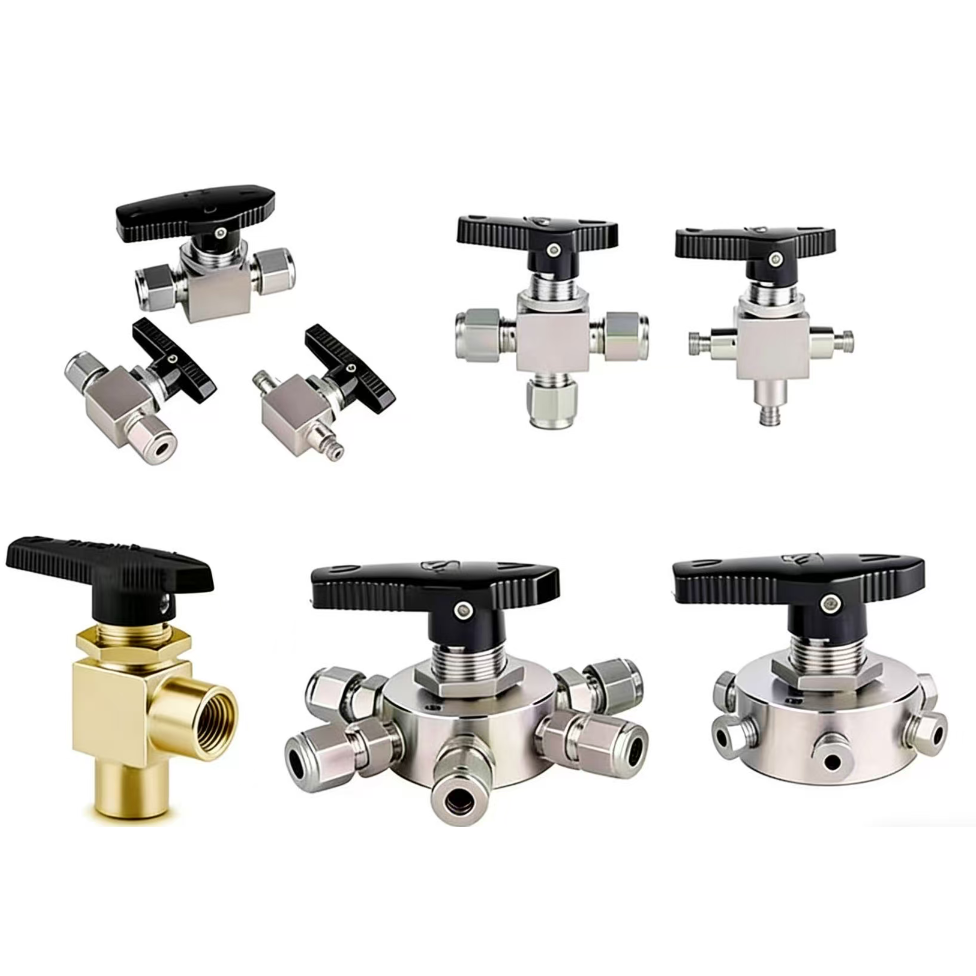
- Product Name:One-Piece Instrumentation Ball Valves
- Materialof the Valve body: 316,304,321,316L,Copper,Alloy 400
- Design: ASME B31.1, ASME B31.3
- End Size: 1/16″ ,1/8″,1/4”,1/2”,3/4”,and 3 mm,6 mm,8mm,10mm,12mm,14mm,16mm,18mm
- Variousend connection Types: Two ferrules fittings,NPT, BSPT,Metric Thread,BSPP, Fractional Tube Fitting,Metric Tube Fitting,Male VCO Fitting ,Male VCR Fitting
- Features:
- Working pressure up to: 3000 psig (207 bar)
- Working temperature: -65°F to 300°F (-54°C to 148°C)
- 2-, 3-, 4-, 5-, 6- and 7-way models for on-off, switching and crossover service available
- One-piece body and one-piece ball stem
- No dead space
- Top-loaded design to allow adjustment with the valve in-line
- Thermal cycle performance improved and wear compensated by live-loaded design
- Any reasonable connections available
- Pneumatic and electric actuator available
- Handle color options available
- Full operating pressure at any port
- The inlet can be any port except for valves with vent ports
- Leak-tight performance testing with nitrogen or compressed air for every valve at the rated pressure to meet the requirement of no visible leak
Application:
- Analytical and Laboratory Systems
This is the most classic application area, demanding extremely high standards for valve cleanliness, response speed, and precise control.
Gas/Liquid Chromatographs: Used as injection valves or switching valves (using multi-port models such as 4L and 6C) to precisely control the flow direction of samples, carrier gases, or solvents, enabling the automation of complex analytical processes.
Online Analyzers: Installed on process pipelines to switch sample gases to different analyzers (e.g., using a 3L three-way valve) or to calibrate zero points and spans.
Laboratory Reactor Setups: Control the on/off and flow direction of reactants. Their “zero dead volume” design prevents cross-contamination.
- Process Control and Instrument Protection
In industrial settings, these valves act as “precision switches” for instrument piping.
Instrument Root Valves/Isolation Valves: Installed upstream of instruments such as pressure/differential pressure transmitters and flow meters. They serve as the primary shut-off to protect expensive instruments and facilitate maintenance and calibration. This is the primary use for two-way (2-way) valves.
Multi-instrument Switching and Venting: Use three-way valves (3-way, 3HL) to connect one measurement point to multiple instruments or to safely divert media to a vent. The vented valve option mentioned in the manual is designed for this safe venting.
Differential Pressure Measurement: Specific three-way valve configurations connect the high and low sides of a differential pressure transmitter and provide positions for equalization and calibration.
- Fluid Distribution and Complex Flow Path Switching
This series demonstrates its most powerful capabilities, suitable for systems requiring complex logic control.
Multi-stream Sampling Systems: For example, using a single 7-port valve allows sequential switching of 7 different process lines to a common analyzer, enabling multi-point (circuit monitoring).
Reactor or Reaction Sequence Control: Using multi-port valves like 4V or 5LV, different reagents can be introduced into a reactor in a programmed sequence, or product flow can be switched to different downstream processing units.
Calibration Gas Blending: Precisely controls the mixing ratio of multiple gas sources for creating standard gases or controlling reaction atmospheres.
- Specific Industrial Scenario Applications
Their materials and design enable them to perform in demanding environments.
Oil & Gas and Chemical Industries: The corrosion-resistant 316 stainless steel body can be used in applications with corrosive media like hydrogen sulfide (the manual notes compliance with the NACE MR0175 standard). Multi-port valves are used for wellhead testing, catalyst injection, etc.
Semiconductor and High-Purity Processes: Valves subjected to special cleaning (meeting ASTM G93 Level C) are used in ultra-high-purity gas and chemical delivery systems to ensure contamination-free operation.
Power and Energy: Used in auxiliary systems like boiler feedwater and steam sampling lines that involve high pressure and temperature.
Skid-Mounted Equipment and Panel Integration: Offering panel mount and bottom screw mount options makes them ideal for integration into analyzer shelters, instrument panels, or packaged systems, saving space and ensuring a neat appearance.
Summary and Key Selection Points
Core Value: This valve is not merely a simple “switch”; it is a precision module capable of implementing complex fluidic logic control.
Reviews
There are no reviews yet.