
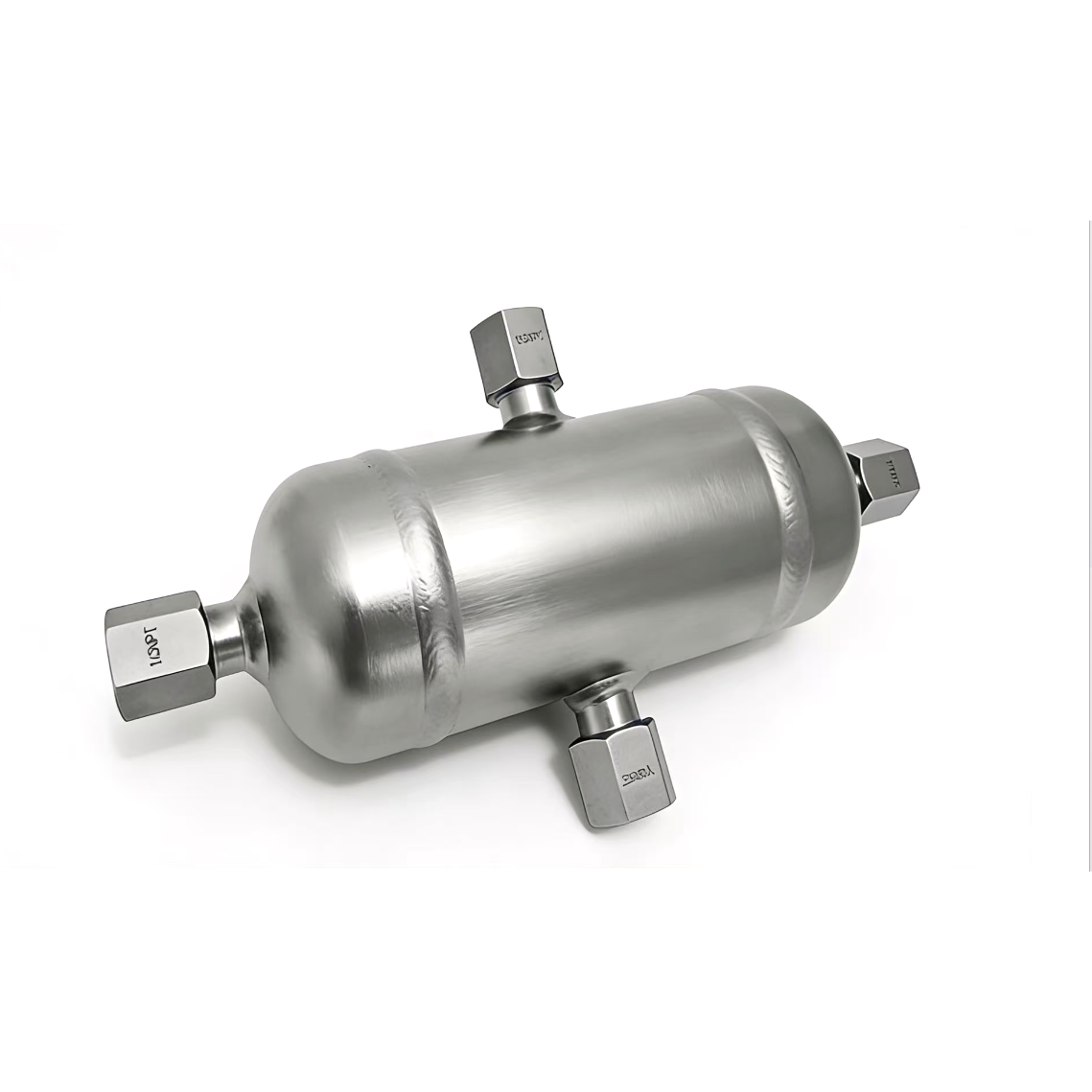
Product Details
- Product Name:Condensate Pots
- Material:316L SS, 304 SS,321SS,A105,A106 or Requested material
- Pressure range:Class 300,Class 600,Class 900,Class 1500,Class 2500
- Diameter options available:NPS3,NPS4
- Connection Type:NPT,BSPT,Fractional Tube Socket Weld,Metric Tube Socket Weld,Fractional Tube Butt Weld,Metric Tube Butt Weld,Pipe Weld Socket,Pipe Butt Weld,Fractional Tube Fitting,Metric Tube Fitting,Fractional Tubing,Metric Tubing,RB-Bleed Valve (normative)
- ConnectionSize:1/8”,1/4”,1/ 2 or 8 mm,10 mm,3/4 or 12 mm,14 mm,
- Connection Type:Male ISO Parallel Gauge Thread (EN),Male NPT,Male Metric Thread,Fractional Tube,Metric TubeConnection
- Size:1/4″,3/8″ or 6mm,1/2” or 8mm ,10mm,12mm,M14×5,M20×1.5,1” or 16 mm
Features:
- Suitable for application with water, oil or gas
- Chambers are made from seamless pipe and weld caps
- 100% Full-penetration gas tungsten arc -weld construction to ensure great strength and leak-tight performanc
- Five pressure ratings available
Application
- Pressure Measurement of High-Temperature Steam or Hot Gases (Most Common)
Application Scenario: On steam pipelines in power plants, chemical plants, and heating systems.
Working Principle and Value:
Cooling and Liquid Seal: High-temperature steam enters the condensate pot and naturally cools, condensing into ambient-temperature water that fills the pot.
Pressure Transmission: The static water column transmits the pipeline pressure equally but isolates the high temperature.
Instrument Protection: Pressure gauges or transmitters come into contact with room temperature liquid instead of steam >100°C, thereby preventing damage from high temperatures, extending their service life, and ensuring stable readings.
- Isolation and Sampling of Corrosive or Contaminated Media
Application Scenario: In industries such as petroleum, chemical, and natural gas, where the medium may be corrosive, prone to crystallization, or contain particulate matter.
Working Principle and Value:
Settling and Isolation: The flow velocity of the medium decreases within the pot, allowing some impurities to settle. For gases, condensation creates a liquid seal.
Clean Contact: Instruments only contact the relatively clean condensate or the upper layer of the medium, preventing corrosion, clogging, or contamination of the sensing elements.
Safe Sampling: Condensate samples can be safely obtained for analysis through additional ports on the pot (e.g., configurations 3A, 4A), avoiding direct handling of hazardous media.
How to Choose:
- Medium and Temperature: Is the medium steam, gas, or liquid? What is the temperature?
- Pipe Pressure: Determine the required pressure rating (Class 300, 600, 900…).
- Instrument Type: Is it a single pressure gauge, or a differential pressure transmitter (requires a 3A configuration)?
- Material Requirements: Select based on the corrosiveness of the medium (e.g., 304 SS is commonly used for steam, 316L SS for chemical environments).
- Connection Size: Must match the interfaces of the field piping and instruments (e.g., NPT 1/2″).
- Or manufacture according the drawing
Reviews
There are no reviews yet.